


Last Candidate Standing: Round 1 Play-by-Play (with video)
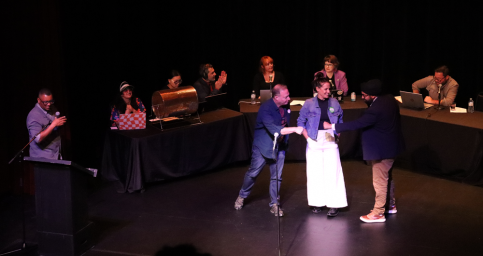
Last Candidate Standing is a ‘debate mixer’ open to all candidates running for Mayor or Council. Structured loosely as a gameshow, the broader aim of the event was to allow community members to learn about the breadth of candidates running for office. The 2026 edition, held on October 1, saw 33 participants join in the fun at the York Theatre in East Vancouver.
Candidates were invited to the stage in randomly selected groups. Each group was given the opportunity to answer a question posed by the Panel of Inquisition. The best answers, as voted on by the Panel, received a pass to the next round. Props were allowed, and a gong was used to assist with time-keeping.
The debate proceeded over seven rounds, with a total of 29 questions asked. The winner was Frances Bula, with Lucy Maloney as runner-up. Quarterfinalists were Rebecca Bligh and Pete Fry.
The following is a verbatim transcript of the questions and answers provided. Only minimal edits have been made. (If you spot any errors in the transcription, please let us know!)
The 2026 edition of Last Candidate Standing was produced by the Vancouver Public Space Network with the support of The Tyee, SFU City Program, Creative Mornings Vancouver and Park People.
ROUND 1: 33 Candidates. 11 sets of three candidates. Two passes issued per set. 60-second answers.
Question 1.1: Please say something positive about a candidate from a party other than your own. Or about an incumbent Vancouver council member from a party other than your own. You can give them kudos for a good idea or policy proposal that you wish you’d thought of. Or congratulate them for their handling of a tricky issue or something else that’s positive.
Kareem Allam (Vancouver Liberals – Mayor) - There’s one person in this room that I’d like to acknowledge, and I want to acknowledge their contributions to the city for two reasons. And that’s Pete Fry. First, it was because of the leadership of Pete and Tom Digby and a couple of Vancouver Liberal Park board commissioners and a collection of Park Board commissioners that we save the democratically elected Park Board. And Pete was probably the strongest voice on council in protecting our democratically elected Park Board, which I want to acknowledge him for that. The second reason, and to me, this is a more important reason why we need to acknowledge Pete Fry is Ken Sim tried to get rid of the integrity commissioner while under investigation from that integrity commissioner, and it was a brilliant political maneuver for the ages that saved not only the integrity commissioner, but got us the report to find out exactly what was going on. So thank you guys so much for your incredible service and leadership in that moment. It meant a lot to me. It meant a lot to everyone in this room. Democracy, transparency are everything. Thank you so much.
Frances Bula (OneCity – Council) - I’m going to pick Rebecca Bly because I saw Rebecca do amazing work when the encampment in Strathcona was on, going down regularly to the site, trying to work with the Park Board and other members of council to come up with solutions down there. She didn’t have to do that. It’s not a regular part of what a councilor does at all. There were actually, you know, not really any meetings at council about it. She just took it upon herself to go down and try to figure out a solution to that very difficult situation where.
Muhammad Ahmad (Bright Future Vancouver – Mayor) - I want to give a heads up to Kareem Allam here. One of my opponents, but, he’s been receiving a lot of hate, and he has been, like, because of his name and because of where he came from. And he stood up not only for himself. He mentioned every single one who was facing the hate thing. And honestly, like I would say, like we started at opposition, but, I mean, we are becoming more like brothers. So thank you.
Kareem Frances Bula and Kareem Allam advance.
Question 1.2: It’s budget time and the Vancouver Police Department has asked for another funding increase without providing a public account of their spending – how do you respond?
John Boychuck (Vote Vancouver – Council) - Leadership has an opportunity to actually stop, think, look, and consider how we can do it better. Allocating funding and just throwing it out there just because you say you need it – isn’ta way of doing things smarter. We say we’ve been working hard but have we? Have we been working smarter? Not really. It’s time for us to take a step back, take a look at how we are spending the money, and determine how we can allocate it properly. There are great programs out there but they’re top-heavy on certain ends. There are great programs out there, but they’re lacking leadership. And that’s one thing that starts right at the mayor’s chair. All I can say is that I think it’s time that we put a woman in charge and make some change to the city and stand up for what we believe in – and that is accountability. Thank you.
Geoff Teoli (Vote Vancouver – Council) - I think you know I’d like to see the city stop writing a cheque to the VPD just for them doing their job. We do support the VPD doing the police work, but I think the City budget really needs to start focusing on all the other things the City can do that the police can’t. And that’s why it’s really important for us to focus on things like supportive housing and getting people off the street into dignified housing, a place where there’s a lock on the door, and all those things that they need – so that a lot of issues that we’re dealing with that aren’t necessarily crime prevention, but social issues, economic issues, getting people good jobs so that they don’t have to just get $10 so that they can so they can survive, and survival crimes can go down. I think those are the issues that we really need to be focusing on, rather than on a police budgetthat, by the way, is 20% higher per capita than anywhere in the country, but the results aren’t any different. So I think we really need to examine that.
Armor Valor (Vancouver Liberals – Council) - A couple months ago I was on the same stage with a different party. But, I’m running with Karim along with the Vancouver Liberals, and my answer is no, I will not give them more funding.
John Boychuk and Geoff Teoli advance.
Question 1.3: Food security is a growing issue across BC, but within Vancouver we see particularly severe food scarcity in certain neighborhoods like South and East Vancouver. There are a lot of different ways that the City can intervene and improve the lives of families facing food insecurity. How would you improve access to nutritious and affordable meals for families in need?
Rebecca Hasdell (Vote Vancouver – Council) - I feel like someone’s going to think that I slipped to 20 to the panel because for the past 20 years of my career I’ve worked as a public health scientist thinking about how we can address food security in municipalities, and I would be so excited to champion this on Council. Ultimately, the thing people need most to be food secure is to have the housing and income that they need, so that they can afford food in communities where they already are. That means lowering the cost of housing for folks, creating more non-market housing, so it eases some of their budget for food, and also making sure that people have the good jobs that they need, so that they have autonomy. But we know that that’s not the case for everyone and we need to meet people where they are right now, and we can use this as an opportunity to build more community connections through food because it connects us so well. I am on board with the pledge from the Vancouver Food Justice Network to create a hub in South Vancouver.
Soloman Yi-Kieran (COPE – Council) - There are a lot of things we have to do about food security. It is a serious issue in our city. First, we want to make sure that the food deserts and the food mirages in South Vancouver and East Vancouver are protecting small local affordable grocers by using City procurement to make sure that they can stay open and keep delivering affordable prices to residents. We want to make sure that we are investing in opening a City-run grocery store, so that folks in the Downtown Eastside have reliable, cheap access to food. We want to make sure that we are tackling the kind of the rates that big corporations are putting on zoning rules. We also want to make sure that we are supporting food recovery from all across the city, so that we are not only reducing the amount that food has to travel as a climate issue, but also making sure that for local restaurants and businesses—the the food that they aren’t going to sell but [instead] throwing out—is able to get into people’s on people’s plates and into people’s mouths.
Amauri Caliman (Independent – Mayor) - My goal, my 100 for my first 100 days, will be to partner up with the private sector and get the restaurants in the areas from the Vancouver School Board and partner with them to provide free food and hot lunch for all the schools in Vancouver. We should stop fighting between private sector and public sector. We should work together, andnd they are out there. They want to do that, but they don’t see the way of doing it. What I want to do as an independent candidate:I’ll listen to both parties and make sure we work for the good of Vancouver, not for political ideology. We want to deliver that for the kids [what] they need so much.
Rebecca Hasdell and Soloman Yi-Kieran advance.
Question 1.4: Is Vancouver a no-fun city? And what specifically should City Hall do to make the city more fun? Unless you believe the city is too fun, in that case, what should City Hall do to make the city less fun?
Bridget Burns (Green Party – Council) - I wouldn’t say it’s a no fun city, but it borderlines on a no fun city, and there’s a lot we can do to make it more fun. And where I see improvements are with permitting and change-of-use in multi-use spaces, allowing independent venues to operate and get business licenses, and not be at risk of getting shut down, making it easier and more cost-effective for them at City Hall. Right now, a lot of them feel really it’s very close, very prohibitive to get things done, get licenses, get permits, change of use. It’s a huge problem. City hall needs to work with them so we can have more fun in the city.
Keerit Jutla (Vote Vancouver – Council) - Now, we all love fun.Who doesn’t love fun? But fun should not be something that only wealthy can afford. This year, we saw the World Cup. I’m a huge soccer nut, I had fun [but]I couldn’t afford to go to any of the games. I couldn’t afford to go to some of the other events in the city, and I certainly couldn’t afford some other services when City Hall decided to spend five extra million dollars instead of providing to the community. What I did see was cities like Toronto actually invest in community-led entities, what I also saw was other cities talk back to FIFA and say you should let Indigenous communities circumvent the licensing fee so they can watch games on their own territories. And what I saw was local community associations being able to have accessibility to fields, parks, social services, because fun should not be expensive. Fun should not be reserved for an upper class. Fun should be all of us together.
Jonathan Weisman (TEAM – Council) - Ask me about my hair later. There are three things I’m going to tell you. Number one is, as we build – and yes, we think we need to build more — we need to make sure that we grow our cultural amenity spaces, our public spaces, so that that grows, so that we don’t lose, we don’t shrink with more people. Number two, we need to be out there in the community, going to events like this, having as much fun as we can every single time, so that people see that leadership at the same time coming from City Hall. And number three, we 100 percent – and I agree here completely with my friend up here on stage – we need to change our permitting process from the permitting process that says, “Well, I have a list of things that you got to do, and you got to come in here and tell me that you’ve done all the list of things” to someone sitting there that says, “I know you want to do something, let’s figure out how to make that work. I’m going to work with you to try to make things happen in the city. That’s what the permitting officers need to be doing. That’s what people at City Hall need to be doing. It needs to be “how do we make it work?” how do we make it happen? Not “come here to satisfy us.”
Keerit Jutla and Jonathan Weisman advance.
Question 1.5: If elected, would you present a publicly accessible line-by-line budget, why or why not?
Pete Fry (Green Party – Mayor) - This feels like a total softball question because that is literally what I’ve been begging for for the last year. I even presented… I did a video with a 600-page how we used to do the budget versus the Ken Sim budget for the zero means zero, which is 25 pages… [and] there were some intentionally blank [pages] and phoes of cannons. No, obviously we can’t make sound decisions if we don’t know where the money’s going, and we don’t know where the money’s going. So this whole zero means zero budget charade is a charade because we don’t know where the money’s going. And the sad thing is, Ken seems to find other ways to spend discretionary funds, like $5 million – no, $2 million – for fireworks, $5 million for the Granville extension, half a million for the bullshit plebiscite that doesn’t actually count. Yeah, show me the money.
Steve Jedreicich (Vote Vancouver – Council) - 1,000% yes. You should have a line-by-line budget. In any business, you need to be accountable and transparent about what you’re spending and what you’re taking in. So, how can you do that if all you have is pictures. … He’s a CPA, so he should be putting out a CPA budget instead of a picture book. I don’t understand how that happened. I don’t know how staff would have… I’m sure they had a whole one ready to be prepared, but it wasn’t allowed to be put out there. So let’s do it. Let’s let everybody look at it. Let’s question what’s not right. Let’s fix it.
Josh Gordan (TEAM – Council) - So this answer I can kind of do verbatim from the speeches that Colleen gives. So this is a big theme of Colleen Hardwick. If you’ve ever gone to one of the Team events, she goes on and on about how we need a line-by-line budget. So this is not just made up on the spot. That is a definite yes. We would want that. She’s been pushing for that for many years, and also in her time [on] Council from 2018 to 2022. I should be talking about myself more, not Colleen, butanyhow, she’s the one. She’s the expert that pushes this. I’m not making this up. She’s been pushing this for a long, long time, and that would get our finances under control much better, so that we have clear accountability. We also need not just that, we need a clear directory of City staff, so that people can actually access the people who are supposed to provide services, so that we can actually get that responsiveness… because that’s one of the things that I’ve heard in communities, that they don’t find the City very responsive.
Pete Fry and Josh Gordon advance
Question 1.6: Do you plan to approve the rezoning for the AI data centre in Mt. Pleasant. And if the data center does go through, what tools, if any, would you use to mitigate the data center’s impact on the surrounding neighborhood?
Annette Reilly (Green Party – Council) - AI data center so the one in Mount Pleasant, the rezoning for that one is so that they can have a restaurant down below. They are currently zoned for a data center, so that is one thing that needs to be taken into account with that particular site. If we’re going to talk about AI data centers in general, I do believe that Lucy Maloney’s motion that she put forward this summer about regulating AI data centers is very important. This is a technology that has been going so fast, and we don’t know enough about it. We need to make sure that we know exactly how this will affect our residents and our environment before we allow these in our city, the massive AI centers that we’re talking about.
Devin Clemens (Vancouver Liberals – Council) - I will not dance up here like Harrison. Nobody wants to see Gumby dance to Carmina Burana. Data centers… it’s not happening. We are not putting data centers on some of Vancouver’s most expensive land. We need to have proper development and consultation with the City. When we look at AI, there are uses for AI. The city is not the place for an AI data center. AI data centers should be built near power sources so that we can properly power those if we are using them. We do need data sovereignty in Canada. It is a federal policy. It is going to come through. When we look at how that should be done, it should be done transparently in consultation with the City, with residents, so that we know – so that everyone knows – what is being done with that policy.
Angela Dawson Rollergirl (Independent – Council) - I’ve been in Downtown Eastside for the last 30 years. I’ve been all over Vancouver. Like all Vancouver. I see the changes. We need housing. AI, I don’t understand – we are human beings, not computers. That is my statement.
Annette Reilly and Devin Clemens advance.
Question 1.7: Vancouver’s current Council directed City staff to find $120 million in savings and new revenue for this year’s 2026 operating budget [in order] to freeze property taxes. They said it was savings and new revenue, but it’s mostly cuts, which includes an estimated 400 jobs, a mixture of unionized and non-union positions. What do you think about the prospect of reducing the size of the municipal workforce? And out of the job cuts that we’ve seen in Vancouver over the past year or two, which specific ones do you agree or disagree with? If you think the City can afford to reduce staff levels, which specific departments and roles should be cut?
Patrick Sauriol (TEAM – Council) - Thank you for the humor-filled question. Reducing taxes. All right. So, what I’ve been learning over the last four months since I’ve been running for office is that there is a lot of things that can be fixed. You can reduce the budget, and you can direct manpower to be smarter. I come from a background in technology. I use analytics every day in my work. The data is there, and the data can be used to actually make things, improve things, make it faster, make it better, get more feedback to the citizens in Vancouver, and you can also keep the jobs without having to go over budget. It’s just a smarter allocation of the manpower that we have. There we go. I wish I had a joke to add to that, but I didn’t get the police one.
Judith Kasiama (Bright Future Vancouver – Council) - That was a really tough question. . But I don’t think that there should be any cuts right now. As we know, a lot of families are already experiencing a lot of job insecurity, housing insecurity, and I think as City Council, we really do need to review our budget [and] see where all the money is going. As we already had a question earlier on about police budget and XYZ, so we also need to look at [the] budget and figure out how do we maintain our staff without having to cut people off or allow folks to be unemployed. So it’s a tough question, but I think this is going to require a lot of working together as well as really reviewing that budget closely. – advancing
Bilal Khan (Bright Future Vancouver – Council) - Pretty loaded question, but let’s see. So to get cash, to increase the amount of money that we get into the City is important, and we definitely should not be cutting any jobs already. It is so difficult for our residents to live here, and we’re already in a job shortage at the moment. What [we] as a city needs to focus on is trying to increase jobs, but also increase revenue by creating different streams of revenue, either by bringing more industries here, doing more local manufacturing, producing more resources here within Vancouver. And yeah, that’s pretty much it. We have to produce more here so we can create more jobs instead of just cutting everything within our own city.
Patrick Sauriol and Judith Kasiama advance.
Question 1.8: Most of the city is zoned for single-family housing, and yet over half of the residents of Vancouver are renters. How would you design community consultations to ensure residents feel heard while also densifying single-family neighbourhoods?
Jarrett Hagglund (OneCity – Council) - I think it’s very progressive to break the status quo and open up more of the city to apartments and four to six-storey rentals across the city. And to do that, we need to talk to neighbors. We need to go and show them the benefits they will get by adding more people to their neighborhoods. Talk to them about what kind of retail they want to see there, what kind of community services they want in place, and then we need to follow up so they actually see what they told us happens. So we need to show them that we are thinking in advance and making sure that we’re putting in pools, community centers, planning for the right kind of retail, so that they can see as the city grows, as density goes up in different neighborhoods, that they’re actually getting benefits that they’re seeing [in their] neighborhoods, not just housing form. And so that’s what we need to do: listen to them and actually put into action before they just see homes go out around them.
Camil Dumont (Green Party – Council) - Before I jump in to my answer, I just want to profess my lifelong appreciation and love for the Panel of Inquisition. I’m going to echo with something Jarrett said – that four to six storey kind of sweet spot. We saw the Villages Plan fail, but I think the ethic behind that was actually pretty good. The concept of walkable cities, concept of being able to get your coffee or go to the pharmacy, whatever, right from your door, and ensuring that that’s city-wideis probably the move. I think we need to use every tool in our toolkit. To quote Lucy Maloney from one of our recent debates, we need to really kind of, get creative and work together to figure out how we can create the housing people actually need here in the city, and do so in a way that doesn’t totally demolish and destroy the amazing history and stories that we already have in neighborhoods here around town. The other thing we have to absolutely avoid is displacing folks who are currently in affordable housing. So as we do this, we have to have an eye on maintaining and strengthening the current affordable housing. Let’s renew those co-op leases, for example.
Caitlin Stockwell (OneCity – Council) - Just before I start, I want to address the elephant in the room: that this is another speaking event where ABC has not shown up. And another elephant in the room related to this question is ABC telling staff to work really hard on a short timeline to get the Village Plan across the line and then voting against it. I think that’s very disrespectful. But we do need to bring community alongside when we’re planning for change. We need to use every tool in the toolbox to address the housing affordability crisis that we have, from rezoning and supporting subsidized housing options in the city as well. And to do that and not have work undone after four years, we need to bring community alongside. So part of that means trying to make sure that who is providing input is representative of the city. So in Toronto, they actually provide subsidies or honorariums to make sure there’s a representative sample of who is in the city providing on projects. And the other thing we can do is go into the communities and say what types of design things would you like to see?
Jarrett Hagglund and Caitlin Stockwell advance.
Question 1.9: In the last year, Vancouver’s only overdose prevention site located in what Vancouver Coastal Health calls the Vancouver City Center area was closed following persistent complaints from mid-town residents of public disorder. Would you approve the opening of more safe consumption sites outside of the Downtown Eastside, and if so, how would you balance concerns of local residents of some neighborhoods with the need for life-saving harm reduction services?
Rebecca Bligh (Vote Vancouver – Mayor) - Yes, yes and yes. I am on the record already for saying yes. Ken Sim took this issue and he said, “as mayor, I’m going to use every tool in my toolbox to make sure that this does not happen.” As mayor, I would say I’m going to use every tool in my toolbox to make sure it works. It’s the same toolbox. It’s just a choice as to whether or not you pull out the tools that allow you to connect with people. These are health services, and the insanity of this position of Mayor Sim on this issue – that I know others in this crowd have taken with me – is that just because you delete the health services doesn’t mean that people who need them go away. And now the next thing we’re hearing – where is my time? – is that people are concerned about people on the street. They’re in the alleys. This is serious, I can’t make a joke. This is too serious to make a joke about. We will bring that [OPS] up. Yes, and every other healthcare service needed.
Iona Bonamis (OneCity – Council) - I completely agree with Rebecca. I would definitely approve and do everything I can to have overdose prevention sites and treatment centers across the city, and I know there [is] a lot of opposition. You know, I have two kids. As a parent, I don’t want to see open drug use on my streets with my kids. And overdose prevention sites [are] a really important part of making sure people have indoor spaces for getting them to safely use. And also, we need other recovery strategies. We need to work with our partners in higher levels of government to have more long-term recovery centers again across the city. And we also need to do more deeper, meaningful public engagement to ensure that we work with the communities and to talk about how we incorporate this, how we incorporate these sites, and how they can become involved in it.
Chloe Leslie (COPE – Council) - I want to be very clear that overdose prevention sites are life-saving healthcare centers, and we need to protect them at all costs. It is disturbing what Ken Sim and ABC have done to prevent this life-saving service from going up downtown. These are critical pieces of public safety infrastructure. We’ve heard a lot about public safety throughout this election process. We want to be really clear that people are safe when they’re able to access resources that they need to survive. That looks like overdose prevention sites. That looks like voluntary care. That looks like working with other levels of government to ensure that we are actually providing safe spaces for all members of our community. Just like any good accessibility infrastructure that we have, when it starts to benefit some people in our community it ends up benefiting everyone. So I think we need to do everything we can to ensure that these sites are not just in the Downtown Eastside, but are also seen throughout our city to make sure everyone is safe. Thank you.
Rebecca Bligh and Iona Bonamis advance.
Question 1.10: This evening’s event is hosted by the Vancouver Public Space Network. I want to ask about public space. What is the best public space in the city of Vancouver, and how could Vancouver learn from other cities to improve its public spaces? Be as specific as possible.
Sean Orr (COPE – Council) – You may have seen me on the news. It’s not true. (If you know, you know). Yeah, so I’m going to talk about something that’s been very close to where I live, and it’s a space that I really love but unfortunately, it has recently been ruined. I am talking about the beautiful Woodward’s Atrium. I see somebody who lives in Woodward’s Building, my neighbor, and somebody also lives in the Woodward’s Building. So this was supposed to be a community space. This was supposed to have community-serving retail and that was supposed to be London Drugs. It had a pharmacy. It had a post office. Had, you know, the National Film Board –and now it has a police training center that costs $5 million to train police when that is not our jurisdiction. That is the jurisdiction of the Province. And now this beautiful space… it’s a dead space.
Lucy Maloney (OneCity – Council) – I think that the best public spaces we have are our streets. So I brought up a Gastown Grand Prix bell that people in the audience were using to cheer on the cyclists. It’s amazing when we use our streets for special events. I want to see more of that. I’d like to see more pedestrianized areas. I’d like to see more parklets. I’d like to see more Montreal-style pedestrian zones that are seasonal and that we can enjoy over summer. But to do that, we need to tackle some of the big issues that we face as a city, like housing, like affordability, like road safety, because public safety includes road safety. That’s a big issue of mine, and if I’m re-elected, I’m certainly going to spend a lot more time harping on about that. Thanks very much.
Stephanie Smith (Green Party – Council) - I’m out in the first round. It’s really difficult to pick a favorite public space in Vancouver because there are so many places where things happen that bring me so much joy. Recently, being outside at Granville Island for the Jazz Festival, or over by the old courthouse – the art gallery – places where we gather, where we have art, where we have community. These places exist all over the city, and so for me, my favorite public space depends on what we’re able to do in it, and so what I would say we should do with all of our public spaces is actually support community gathering in those spaces, especially supporting festivals, supporting artists so that we can all go gather together, enjoy the arts and culture that the folks in Vancouver create. Last but not least, I understand public space in that so much of what we have here belongs to us as a public. Things like public views, public waterfront. I think it’s really important for the public [they are] not privatized..
Sean Orr and Lucy Maloney advance.
Question 1.11: So, with one of the plebiscite questions, we hear a lot about involuntary care for people with mental health and substance use issues. What would you do to improve access to regulated and accessible voluntary care in the city?
Andy Lin (Bright Future Vancouver – Council) - I just want to say I love the sweater. I used to be a women’s fashion designer, and it slays, and it’s really fire. But that’s beside the point. In terms of voluntary care, we all know constitutionally it is a violation of everyone’s rights, and it’s just like, hey, you know, this person is allegedly a drug dealer, drug user, drug whatever, we’ll send them away. Like it’s a slippery slope. But in terms of voluntary care, I’m very passionate about improving real voluntary care for people in the forms of supportive housing with nurses and doctors on site with resources. To treat our drug issue is to really treat the root causes of our drug issue, which is to improve the material aspects of everyone’s life, of the working class, to ensure that everyone has food on their table through our City-run grocery store program everyone has a place to live from supportive housing, rent-to-own housing program as well, and building affordable City-run rentals on City-owned land, which we can go all into it. But it’s to really improve….
Bhavna Solecki (Vote Vancouver – Council) - So, for the question, first of all, nobody wants to be a drug user. First of all, we have to really have compassion. These are humans. They’ve gone through, you know, journey in their life. Something has happened, and they’re on the street. So my approach to voluntary care is an integrated system. We need to have a holistic approach, and first of all, go and see, layer by layer, who are these people, what are their needs, and what do they need? A holistic approach will give us a meaningful and purposeful solution. Just dumping them or saying we need involuntary care beds is not the solution. We really need to bring…
Ibrahima Cisse (Bright Future Vancouver – Council) - People just need to be heard, felt, and understood. A lot of times, people just get neglected, and one of the things that we have at Bright Future Vancouver is the Aurora program. So what that means is anyone who has a situation is going through something very drastic, […] the program, is going to help them not just with the mental health side. We’re also going to help in a sense so they have opportunities, whether it’s career, whether it’s education. And that’s something that we will implement. And again, we need to get together. We need to actually understand the individual. Every single person is their own individual. And sometimes we focus on the grand scale, but each person is their own person. So the biggest thing for me would be just communicating and really understanding what the person’s going through and who they are as individuals.
Andy Lin and Ibrahima Cisse advance.
Candidates who received passes proceeded to the second round of Last Candidate. A play-by-play of Rounds 2 to 7 can be found here.